Our researchers target neurodegenerative disease management like Alzheimer’s Disease. The dedicated group in Funigen R&D is focused on identifying new efficient biomarkers, new diagnostic criteria, medical decision support systems and Brain-Computer Interface Environments for Audio and Visual representations and manipulations of brain activity (https://pubmed.ncbi.nlm.nih.gov/28408880/).
Citation: Alexiou A, Mantzavinos VD, Greig NH and Kamal MA (2017) A Bayesian Model for the Prediction and Early Diagnosis of Alzheimer’s Disease. Front. Aging Neurosci. 9:77. doi: 10.3389/fnagi.2017.00077
Alzheimer’s Disease
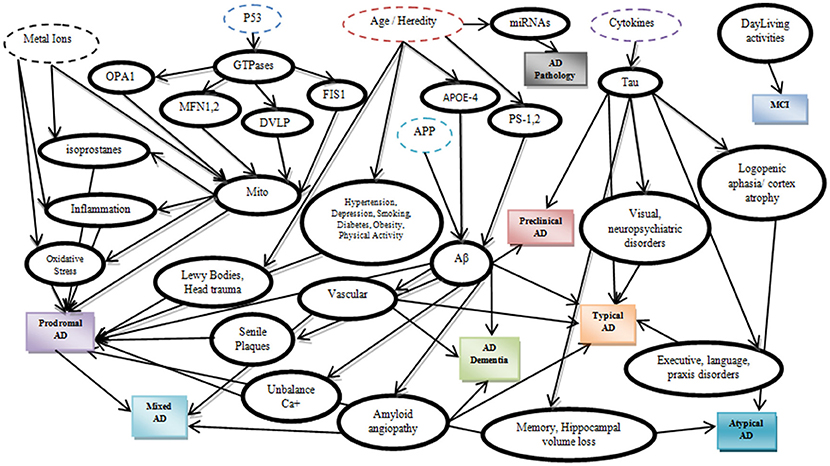
The actual etiology of Alzheimer’s disease (AD) is still unclear, while several risk factors have been recognized to affect the early onset and progression of the disease catalytically. According to the latest studies, AD can be categorized into eight different categories according to risk factors, symptoms, and pathophysiological lesions. Furthermore, these eight categories can be analyzed in depth by adding potential biomarkers in each category that have been proven to affect the severity of the disease (https://www.ncbi.nlm.nih.gov/pmc/articles/PMC5684784/).
AD Dementia: The composite daily life activities’ social function is obstructed. This state is the threshold between memory changes and one more cognitive factor.
Alzheimer’s Pathology: Senile Plaques and neurofibrillary tangles, loss of neuronal synapses, amyloid deficits in the vascular cerebral cortex.
Atypical AD: Progressive aphasia, Logopenic aphasia, frontal AD morphology and cortical atrophy at the posterior section. Also is supported by amyloidosis biomarkers in the brain or CSF.
MCI: Individuals that abstain from AD’s clinicobiological character and have measurable MCI. Those individuals may suffer from AD, but there is no evidence for AD.
Mixed AD: Incidents that validate the diagnostic AD requirements for typical AD and there are disorders such as cerebrovascular disease or Lewy Bodies disease.
Preclinical States of AD: This state includes an in vivo amyloidosis evidence of the brain, or individuals whose families have the autosomal dominant mutation of AD.
Prodromal AD: Clinical Symptoms, memory disorders, Hippocampal volume loss and biomarkers of CSF that lead to AD pathology.
Typical AD: Progressive memory loss, cognitive disorders and neuropsychiatric modifications.